
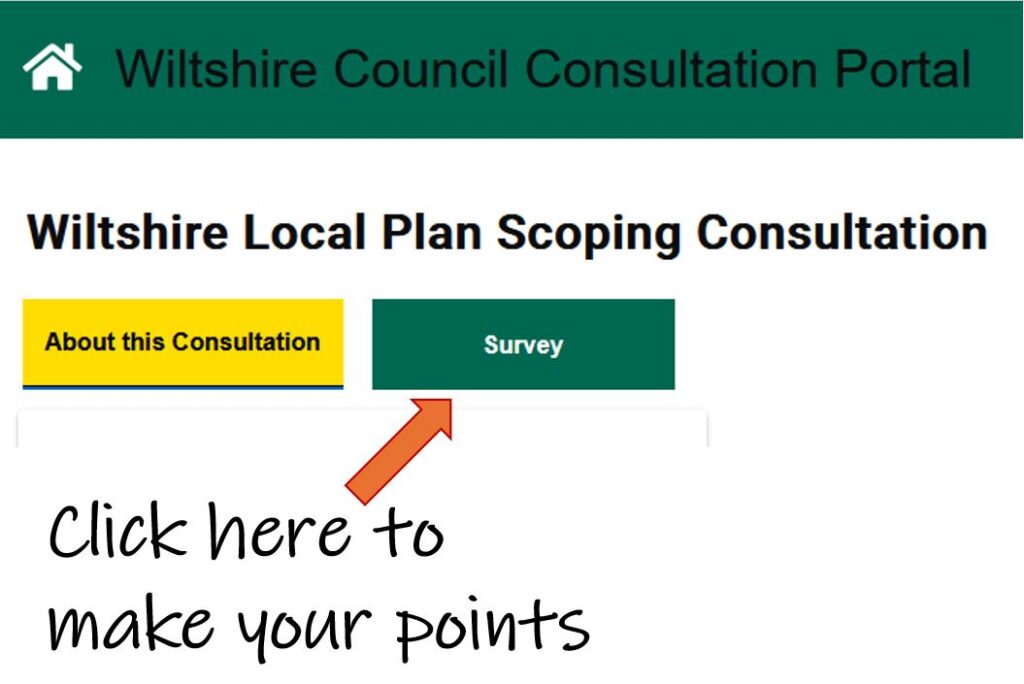
The current consultation is the scoping stage for the new Wiltshire Local Plan, rather than consultation on individual housing sites. It asks what the Local Plan should contain and how Wiltshire should engage with communities.This is your opportunity to have your say/influence the scope of the Local Plan rewrite. The Scoping Consultation phase is from 2-30 Sept 26 and to register your views you should go the Wiltshire Council Planning portal.
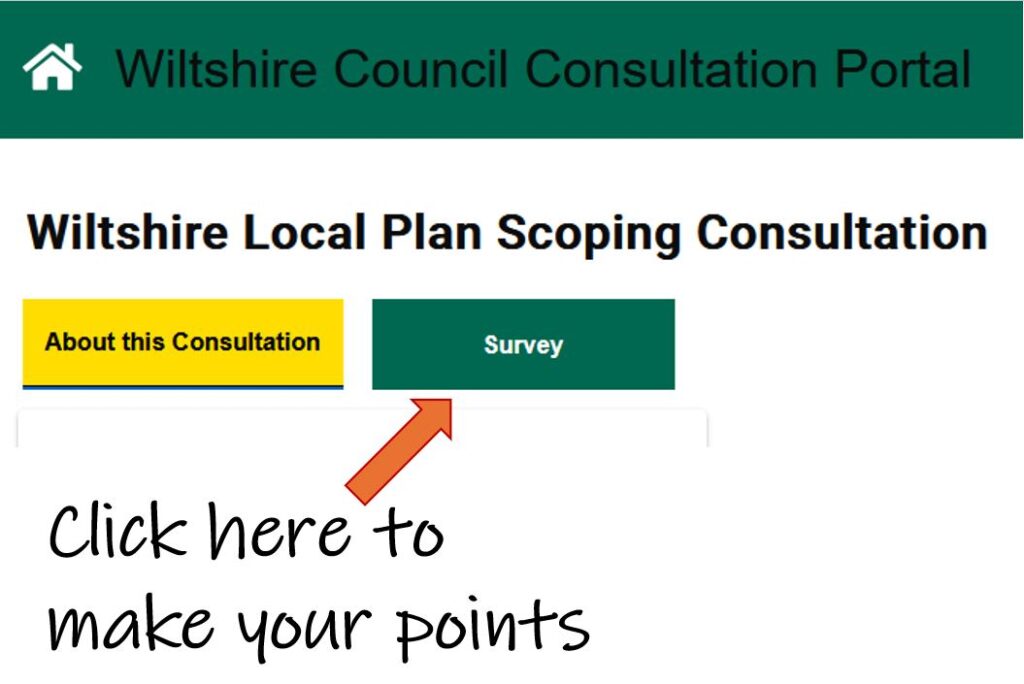
Use Wiltshire Council’s consultation portal at: https://consult.wiltshire.gov.uk/kpse/event/6352DC21-8F55-4087-B574-3CB6C8F868FF. Create an account, open the “Wiltshire Local Plan” consultation, and submit your comments against the relevant questions before 30 September 2026.
Make each point easy to use:
- State the place/site or policy issue.
- Say what you support, object to, or want changed.
- Give a concise reason and any evidence—e.g. common-lizard sighting, dated photographs, habitat survey, mapped habitat features, flood risk, traffic, infrastructure.
- Ask for a specific outcome, such as “identify this land as a biodiversity constraint and require a reptile survey before allocation or development.”
You can also send a short, evidence-led representation to your parish/town council and Wiltshire councillor, asking them to submit it as part of their formal response. Keep copies and submit during every later consultation stage too—the first consultation shapes the scope, while later ones deal with the actual policies and allocations.
Some thoughts you may want to consider /include:
1. Warminster’s development trajectory must be properly assessed
Ask Wiltshire to ensure the new Local Plan’s evidence base starts with the actual cumulative position at Warminster, rather than an outdated baseline.
Specifically:
- WWUE;
- Jubilee Gardens;
- other existing allocations;
- permissions;
- recent approvals;
- current applications;
- brownfield opportunities;
- infrastructure commitments.
2. Town-wide flood-risk evidence
Ask the new Local Plan to:
- identify whether a current town-wide strategic flood-risk assessment exists for Warminster;
- explain how cumulative development is assessed;
- incorporate all relevant flood sources;
- consider climate change;
- assess surface-water and drainage interactions;
- consider cumulative effects across the catchment.
3. Phosphate / nutrient evidence
This deserves a specific Local Plan representation.
Ask Wiltshire to:
- establish a current evidence base for the River Wylye / River Avon SAC nutrient pathway;
- explain how nutrient mitigation credits are being applied to development at Warminster;
- identify the geographical limits of mitigation;
- address headwater/upstream considerations;
- assess cumulative nutrient effects;
- ensure mitigation is demonstrably effective before relying upon additional development capacity.
4. Headwater development should be treated explicitly
Ask the Local Plan methodology to recognise that settlements at the upper end of a river system can present different mitigation circumstances from downstream locations.
The Local Plan should not treat:
“same catchment” as automatically equivalent to: “same environmental impact/mitigation opportunity.”
5. Site-selection methodology
Ask for transparent site-selection criteria that give appropriate weight to:
- flood risk;
- surface water;
- groundwater;
- drainage;
- nutrient constraints;
- landscape;
- heritage;
- archaeology;
- biodiversity;
- infrastructure;
- transport;
- cumulative effects.
And ask that these criteria be applied consistently to all Warminster sites.
6. Landscape capacity around Warminster
Ask for an updated assessment of:
- settlement-edge sensitivity;
- important views;
- landscape character;
- visual prominence;
- historic landscape;
- cumulative effects of development around the town.
This is particularly important because Home Farm demonstrated how significant the landscape question can become when strategic housing is proposed around Warminster.
7. Heritage and archaeology
Ask that the Local Plan evidence properly consider:
- designated heritage assets;
- their settings;
- non-designated heritage assets;
- archaeology;
- cumulative effects on the historic character of Warminster.
8. Brownfield-first / previously developed land
Ask the local Plan to establish a robust methodology for identifying and prioritising:
- town-centre brownfield;
- previously developed land;
- redevelopment opportunities;
- redundant institutional sites.
The former Warminster School Prep site is an obvious example that should be captured in the evidence base.
9. Infrastructure must precede or accompany growth and gauged accumulatively
Ask for development allocations to be tested against:
- GP capacity;
- schools;
- highways;
- public transport;
- walking/cycling;
- wastewater;
- surface-water drainage;
- community facilities;
- open space.
Not simply whether infrastructure can theoretically be provided through S106/CIL.
10. Cumulative effects must be assessed at settlement level
This is particularly important.
Ask Wiltshire to stop assessing major sites purely as individual propositions where the combined effects could be materially different.
For Warminster, this should include:
- flood risk;
- nutrient loading;
- traffic;
- landscape;
- ecology;
- infrastructure;
- wastewater;
- pressure on services.
11. Relationship between WLP and NP2
Ask Wiltshire to make clear how the new Local Plan will interact with the emerging NP2.
In particular:
- What happens if NP2 contains no allocations?
- How will Warminster’s locally generated evidence be incorporated?
- How will the Town Council/community have meaningful input into strategic site selection?
- Will the Local Plan revisit sites rejected or removed through NP2?
- How will locally specific evidence be carried forward?
12. Community engagement
Because the the Local Plan will take 30 months to write, ask Wiltshire to commit to meaningful settlement-level engagement, rather than relying principally on county-wide consultations.
For Warminster that should include:
- early publication of site-selection evidence;
- sufficient time to scrutinise technical evidence;
- engagement with the Town Council and community;
- engagement with local organisations;
- publication of cumulative infrastructure assessments;
- transparent explanation of why sites are selected or rejected.
13. Evidence must be current at the point of allocation
This is worth making explicitly.
Ask Wiltshire not to rely on:
- old flood studies;
- old housing trajectories;
- historic infrastructure assessments;
- outdated nutrient assumptions;
- superseded landscape assessments.
The new Local Plan should require evidence to be updated when circumstances materially change, before sites are allocated.
14. Strategic housing numbers should not drive site selection prematurely
Ask that the process be:
need → constraints → capacity → infrastructure → site selection
rather than:
housing number → sites needed → technical mitigation found afterwards.
Any confusion or questions please do not hesitate to contact EBBRAG.
Regards Administrator